My Thesis
J.P. Daughton’s An Empire Divided: Religion, Republicanism, and the Making of French Colonialism, 1880-1914 is valuable to our understanding of the multifaceted nature of French colonialism. In comparison to our other readings, Daughton’s heavily centralizes on the French colonizer lens and its complex nature, giving French missionaries a more humanistic platform for their justification for colonialism. Throughout the reading, it is apparent that differing ideologies between Catholic missionaries and republicans have called to question France’s own approach to foreign policy and religious politics.
Daughton’s Thesis
Within the Indochina section of his book, J.P. Daughton argues that colonialism was heavily shaped by conflict between missionaries and secular French antagonists. Through his case study exploring Indochina, Daughton finds that ideologies of religious workers and French republicans shifted due to local conditions of the French colonies. Questions of French missionaries created an enigma in religious politics, whether colonialism was vehemently condemned or an opportunity to civilize.
Introduction
While we’re only exploring the Indochina section of Daughton’s book, the overarching premise of An Empire Divided offers an analysis of French people with different backgrounds, moral codes, and political perspectives that shaped colonial politics between 1880-1914. The 1880’s was an era of mission civilisatrice, which rallied folks to seize overseas possessions (Daughton, J.P, An Empire Divided, pg. 5). This justification for civilization promised to reform, educate, and improve the lives of France’s new colonial populations through the inexpensive means of Catholic missionaries. Friction between republicans and missionaries dates back to the eighteenth century with reformers who criticized the wealth and monarchy of the Catholic Church. The emergence of secularism and building a society off liberty, equality, and fraternity created an ideological paradox between the rationale for Catholic missionaries aboard.
French Influence in Indochina
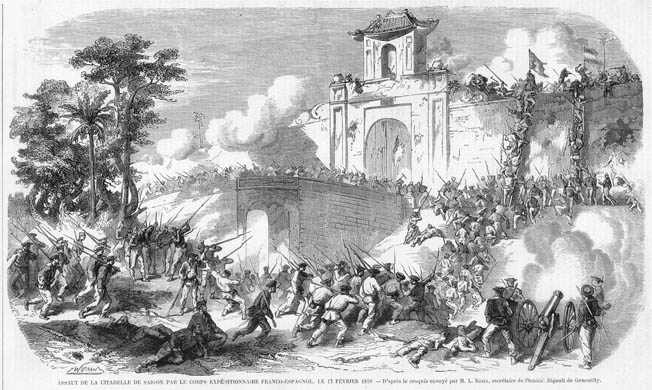
Catholic workers regularly sought French diplomacy and military support to defend what they considered to be right to evangelize. Prior to an official colonial presence, French missionaries were the nation’s defacto representatives. However, Daughton argues that missionaries were underestimated in their commitment to French colonial rule. “Historians take for granted that religious workers wanted to live under French colonial rule, something many Frenchmen doubled greatly,” (Daughton, J.P, An Empire Divided, pg. 61). The French pro-colonial policy emphasized the nation’s civilizing goods, while in actuality officials in Indochina were centralized on day-to-day operations valuing security and allegiance. This fractured state of moral justification created a dichotomy, which is exactly what Daughton aims to highlight.
A significant example of incongruent religious politics is the story of Pigneau de Behaine in 1787, a French bishop working in Cochinchina. Pigneau tried both seeking help for Nguyen Anh, a prince who lost his family’s patrimony to a domestic rebellion, and to protect the future of Christianity. After the failure of the Portuguese military to provide assistance and the lack of response from Louis XVI for signing a military treaty, Pigneau helped Nguyen Anh create his own small Vietnamese army. Pigneau died before being able to see Nguyen Anh grow to become Emperor Gia Long.
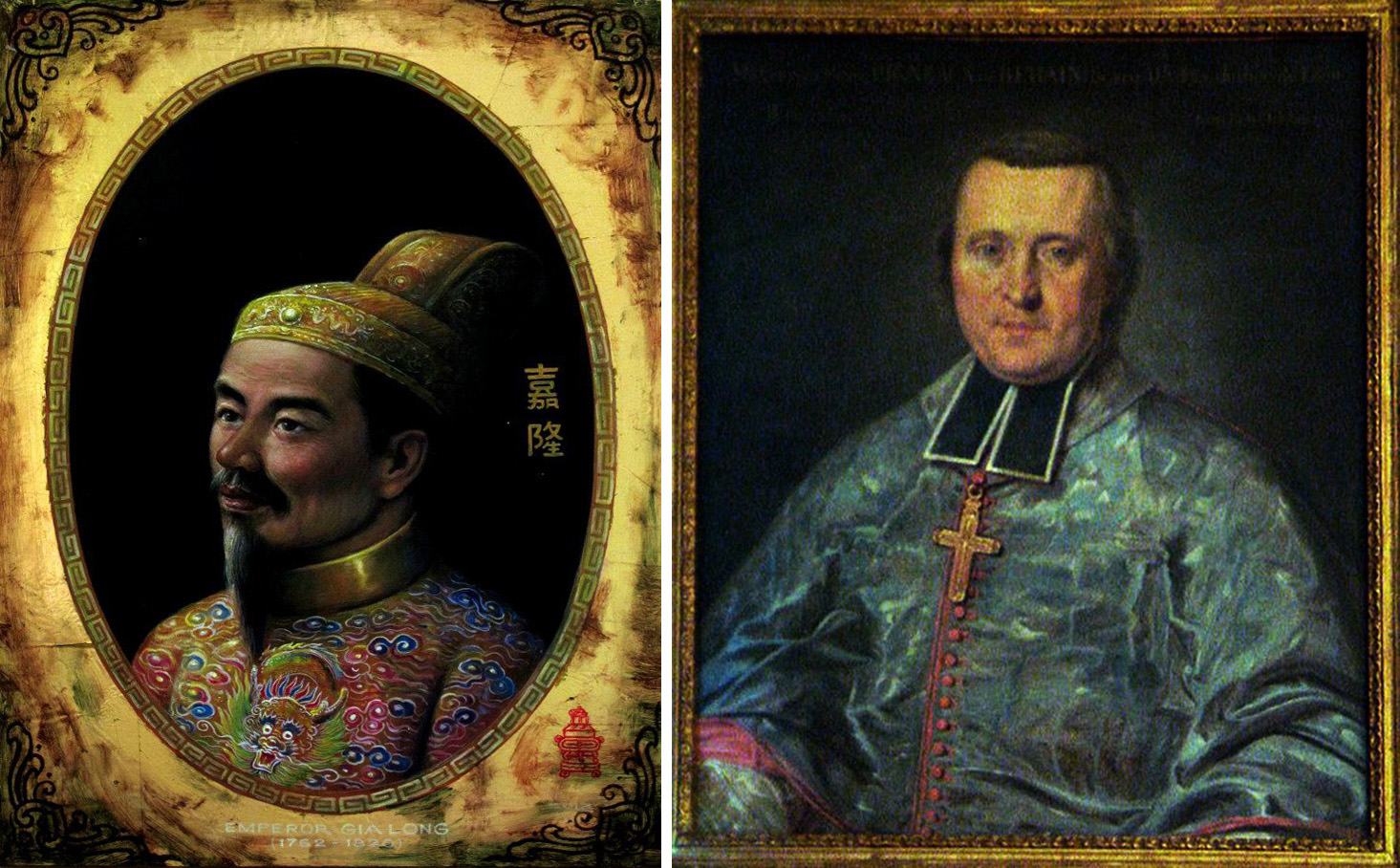
Emperor Gia Long (Nguyen Anh) on the left and Pigneau de Behaine on the right
Daughton uses Pigneau’s story to outline the ambigious relationship that this left between Catholic missionaries, the Vietnamese throne, and the French crown. Since Pigneau’s death, approximately two decades of anti-Christian violence and killing of tens of thousands Vietnamese converts ensued. This also intensified the glorification of martyrdom. Many on the Catholic right used violence in Asia to paint republican policymakers as cold and murderous for ignoring the mission’s central goal (Daughton, J.P, An Empire Divided, pg. 65-66).
Daughton notes the significant impact of the French presence in Indochina, specifically Vietnam. The role of a bishop was vital in blurring the lines of consistency when it came to French colonial politics. Bishops helped the French catch pirates, slave off rebellions, and avoid war. There were more than 350,000 Catholics in Indochina, with a majority coming from Vietnam, over 150 French missionaries, 225 indigenous priests who could preach in more than 700 churches and chapels, 9 seminaries, and more than 600 schools and orphanages that taught over 10,000 students. It’s important to reiterate the aspect of my thesis that states that Daughton is heavily focused on humanistic perspective from the colonizer lens.
It wasn’t until the early 1900’s that missionaries started to define their work on the Freemasons terms. There was a new adaptation of a love for nationalism and God as Daughton points out missionaries “spreading influence through disseminating French ideas, languages, and economic programs,” (Daughton, J.P, An Empire Divided, pg. 105). The real question Daughton leaves up to ask is “to destroy, enslave, and steal; or to teach, moralize, and civilize?” (Daughton, J.P, An Empire Divided, pg. 108).
Compared to Other Texts
While Daughton focuses on the relationship between French missionaries and republicans, there is an imbalance when considering the colonized perspective. This doesn’t mean to say that Daughton undermines this lens at all, rather he acknowledges that the moral ambiguity of French religious politics came at the expense of colonized lives. In reference to the outbreak of war in Europe in 1914, Daughton outlines the strife between missionaries and its critics. “In 1916, after thirty years of trying to convince the French administration that they were committed to the cause of mere-patrie, missionaries and Vietnamese Catholics had the dubious honor of proving it with their lives,” (Daughton, J.P, An Empire Divided, pg. 118)
Michael Vann and Liz Clarke’s collaboration in The Great Hanoi Rat Hunt reveal the Vietnamese agency in relation to the impact of disease, modernity, and empire in the French colonial state in Vietnam. A new system of slavery, “coolies,” and the horrid experiences that the Vietnamese had to undergo reveal a much more graphic interpretation of the French presence in Vietnam. Furthermore, Red Earth: A Vietnamese Memoir of Life on a Colonial Rubber Plantation by Tran Tu Binh focuses on Binh’s negative and violent experiences with the rubber plantations. Specifically, Binh centralizes on the abusive interactions with priests and the forms of resistance the Vietnamese could practice within their limitations.
Works Cited
Daughton, J. P. “Indochina.” An Empire Divided: Religion, Republicanism, and the Making of French Colonialism. Oxford: Oxford UP, 2006.
Vann, Michael G. The Great Hanoi Rat Hunt: Empire, Disease, and Modernity in French Colonial Vietnam. New York: Oxford University Press, 2019.
Binh, Tran Tu. The Red Earth: A Vietnamese Memoir of Life on a Colonial Rubber Plantation. Athens: Ohio University Press, 1985.

